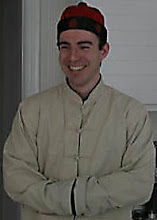
Can someone explain to me why Chinese people have such small feet? I see men all the time who are as tall or taller than me, but I can't find a decent pair of shoes in my size. Now I don't have large feet, exactly average for shoes sold in North America. So can anyone give me a reasonable explanation as to how Chinese people don't constantly fall over from the sheer tininess of their lower extremities in contact with the ground? I think it must be super duper balance, which would also account for all those gold medals at the Olympics. If you see how they like to squat on curbs and the edges of any other large, inanimate objects, you may agree.
http://www.travelblog.org/Photos/1505340.htm
Tuesday, February 17, 2009

Monday, February 2, 2009
Chinese New Year
I recently returned to Chongqing after spending the Chinese New Year with a family in Hunan province. I was invited by the woman who works in the foreign affairs department at the university, Juliya, and we stayed most of the time in her family's old apartment in a town named Taoyuan. It wasn't always the most fun, but was packed full of the essential Chinese cultural experiences, and I was definitely in parts of China where no foreigners would ever go.
The morning of New Years day sounded like a war zone, firecrackers going off non-stop. We woke up just before 6:00am, b/c in that area of China it is the tradition to have a big family meal before sunrise. We were then off to the rural village where Juliya's husband grew up, to visit the tomb of his parents. It became very obvious why Juliya's husband loves reading and is a professor - it allowed him to get away from that kind of desolate, rural life.
I also witnessed drunk, middle-aged Chinese men singing Karaoke, and understand how they get so drunk. They drink baijiu, more than 50% alcohol, out of teacups, and at dinner parties there are endless toasts. Each person goes around the table and forces everyone individually to drink. At the dinner party I attended there was a special toast for me - something about improving Chinese-Canadian relations, as well as a mention about Dr. Bethune.
Stone Forest - Shilin


Just as it sounds. There was the main area where all the Chinese tourist groups went around, with people selling the usual tourist stuff, and then there were more secluded areas. Sticking around till dusk was a good decision, as the place became much more surreal.
Wild Elephant Valley and Nature Reserve


There were no elephants to be seen, but you could have a picture taken and photo-shopped to make it look like you were standing in front of one. Best part of the place was the cable car ride.
Wednesday, January 21, 2009
Xiding


From Jinghong we got in a little Chinese style mini-van and left for a small town named Xiding. Starting out early in the morning it was difficult to see outside the windows, and there was little to see besides flat, desolate farmland. Then once we got passed another town, where most tourists stop for the day, the landscape and scenery improved (though the road got noticeably bumpier). All of the sudden we were seeing mountains pop up through the clouds of fog.
Up one mountain we rode, our final destination being where the town holds its weekly market (plus a nice, white pagoda). There was nothing spectacular about the market itself, but there were some Hani women in their finest head gear. Our driver took us to the restaurant in the area, where he seemed to be friends with everyone, even helping prepare the fish for lunch. We had what I consider to be just about the tastiest meal since living in China, accompanied by travel companions from the UK and Austria.
On the way back from Xiding we stopped off at a small Buddhist monastery/pagoda, and then a tiny village on the side of the road. It felt a little strange walking into this village for no good reason, and then being accosted by a few women wishing to sell the white folk all their tourist nicknacks.
Sunday, January 11, 2009
Xishuangbanna


Our next stop after Kunming and the Western Mountains was Xishuangbanna Dai Autonomous Prefecture. It is the southern most part of Yunnan, bordering with Burma and Laos. Quite different from other areas of China, the Han Chinese are not the majority in the area, the largest ethnic group being the Dai, and it feels like you have entered a new country that is half Chinese, half Thai. The name of Xishuangbanna was established in 1570 during the Ming Dynasty, at which time the area was divided into 12 sub-districts, or "Xishuang" (meaning 12 in the Dai language), for the purpose of collecting taxes. In the Dai language, a "Banna" is one thousand Mu, a unit of measurement in Chinese similar to an acre.
From Kunming we took a 10 hour ride on a sleeper bus (I didn't fit in my bunk) to Jinghong, the capital city of Xishuangbanna, which by Chinese standards feels like a little town. There is nothing much going on in the city itself, but it is a hub for travellers looking to explore the surrounding countryside. We simply sat around in a foreigner friendly cafe and met other people who were looking to share the cost of hiring a driver for the day.
From Kunming we took a 10 hour ride on a sleeper bus (I didn't fit in my bunk) to Jinghong, the capital city of Xishuangbanna, which by Chinese standards feels like a little town. There is nothing much going on in the city itself, but it is a hub for travellers looking to explore the surrounding countryside. We simply sat around in a foreigner friendly cafe and met other people who were looking to share the cost of hiring a driver for the day.
Saturday, January 10, 2009
Kunming


Over the Christmas/New Year holidays I had a visit from the beautiful Miss Tanya Erassova. We spent a week traveling through Yunnan province. Our various modes of transportation were complete with trains, planes, and automobiles.
Our first stop was in the provincial capital of Kunming, aka Spring City - it never gets too hot in the summer, and never too cold in the winter. Kunming itself isn't all that interesting, just another big Chinese city, but it was nice to be able to differentiate the sky from the clouds for a change.
We spent one day just outside the city in an area called Xishan (Western Mountains). Getting there was interesting, and provided the first instance in which I realized that my guide book was not to be trusted. Once there we climbed high up the mountain in search of something called the Mini Stone Forest, only to discover that there were just a few small rocks next to the path.
The first 3 pics are from Xishan. The last is from the centre of the city, and needed to be taken quickly, because of all the people begging the foreigners for money, intent on ruining our pictures.
Subscribe to:
Posts (Atom)